The Complete Guide to Property Valuations
Learn the full hierarchy of real estate valuation methods and how to apply techniques including discounted cash flow (DCF) modelling, cap rate analysis, term & reversion, residual valuations, and comparable methods in line with industry standards and RICS guidance.
DIFFICULTY LEVEL: Beginner
CPD HOURS: 5.0
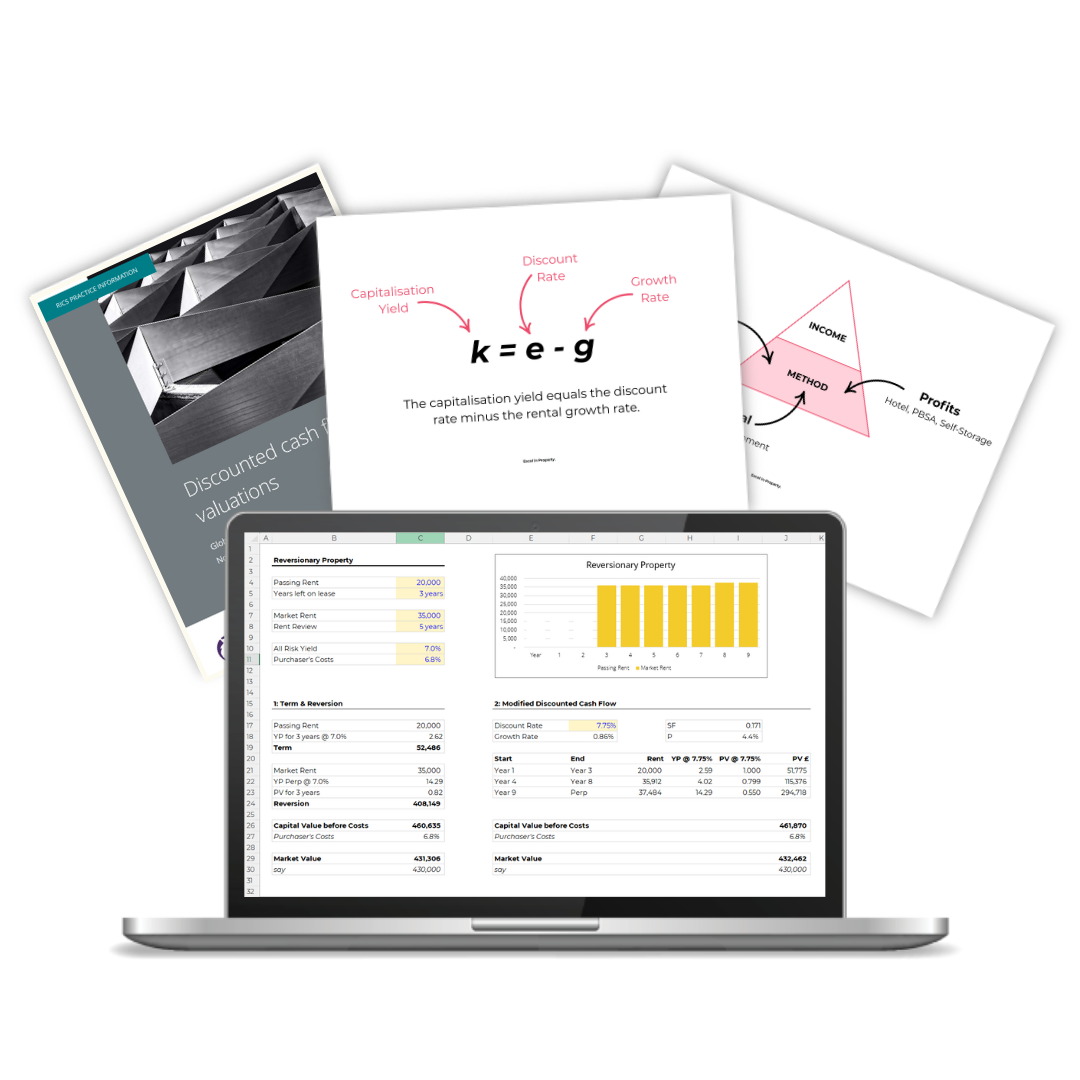
The Complete Guide to Property Valuations
Learn the full hierarchy of real estate valuation methods and how to apply techniques including discounted cash flow (DCF) modelling, cap rate analysis, term & reversion, residual valuations, and comparable methods in line with industry standards and RICS guidance.
DIFFICULTY LEVEL: Beginner
CPD HOURS: 5.0
Course Overview
Understanding how to value property correctly is one of the most important technical skills in commercial real estate. Whether you work in valuation, investment, development, lending, or asset management, the ability to apply valuation methods confidently and justify assumptions clearly is essential.
This course provides a practical introduction to the core valuation approaches used across commercial real estate, helping you understand not only how different methods work, but when and why they should be applied.
You’ll learn the hierarchy of valuation methods, the difference between implicit and explicit valuation techniques, and how to apply approaches including income capitalisation, term & reversion, residual valuations, and discounted cash flow (DCF) modelling using real-world examples.
The course also explores the professional standards that underpin valuation practice, including the RICS Red Book and International Valuation Standards (IVS), making it particularly valuable for APC candidates, graduate surveyors, and anyone involved in professional valuation work.
Whether you are preparing for your RICS APC, working in valuation, or looking to strengthen your understanding of real estate valuation principles, this course provides the technical foundation needed to analyse and interpret property
What you will learn
By the end of this course, you’ll be able to:
Explain the difference between price, value, and worth in commercial real estate
Understand the hierarchy of real estate valuation approaches and how they are applied
Identify which valuation methods are most appropriate for different property types and scenarios
Source appropriate market inputs and justify valuation assumptions clearly
Understand the role of the RICS Red Book and International Valuation Standards (IVS) in valuation practice
Apply income capitalisation techniques in commercial property valuations
Understand term & reversion valuation methodology and calculations
Build and interpret discounted cash flow (DCF) valuation models
Analyse discount rates, discount factors, NPV calculations, and cash flow timing assumptions
Understand the principles behind residual valuation methods used in development appraisals
Compare implicit and explicit valuation methods used across the real estate industry
Develop stronger technical knowledge for valuation work, investment analysis, and APC preparation
Who this course is for
This course is designed for anyone looking to strengthen their understanding of commercial real estate valuation and property financial analysis.
It is particularly valuable for:
Graduate surveyors and APC candidates
RICS trainees preparing for valuation competencies
Commercial real estate valuers
Real estate analysts and investment professionals
Development and asset management professionals
Students looking to understand discounted cash flow (DCF) analysis and valuation methodology
Anyone involved in property valuation, underwriting, or investment decision-making
No advanced valuation knowledge is required.
Ready to strengthen your Valuation skills?
Join the EiP Academy to access this course alongside the full library of real estate financial modelling training, live support sessions, downloadable tools, and practical commercial real estate case studies.
FAQs
Is this course suitable for RICS APC candidates?
Yes. This course is highly relevant for APC candidates preparing for valuation competencies and professional practice. It covers core valuation methods, valuation standards, and principles aligned with RICS guidance.
Do you cover discounted cash flow (DCF) modelling?
Yes. The course includes a practical introduction to discounted cash flow (DCF) valuation methods, including discount factors, NPV calculations, and cash flow timing assumptions.
Is this course focused on UK commercial real estate?
Yes. The training is based around UK commercial real estate valuation principles and references professional standards including the RICS Red Book and International Valuation Standards (IVS).
Will I learn different property valuation methods?
Yes. The course covers a range of valuation techniques including income capitalisation, term & reversion, residual valuations, and discounted cash flow (DCF) analysis.
Is this suitable for beginners?
Yes. The course is designed to build strong valuation foundations while also providing useful technical depth for professionals already working in the industry.
Are downloadable files included?
Yes. The course includes downloadable valuation workbooks and practical examples to help reinforce your understanding of valuation techniques and calculations.

FOLLOW US


COMPANY
CUSTOMER CARE
LEGAL
Copyright © 2026. EiP. All Rights Reserved.