
What Is Internal Rate of Return (IRR)? A Practical Guide for Real Estate Investors.
What Is Internal Rate of Return (IRR)? A Practical Guide for Real Estate Investors.
The internal rate of return (IRR) is one of the most widely used metrics in investment analysis, particularly in real estate and private equity. It measures the annualised rate of return generated by an investment over a defined holding period and is expressed as a percentage.
More precisely, IRR is the discount rate that sets the net present value (NPV) of all future cash flows equal to zero. In other words, it is the rate at which the present value of expected inflows equals the initial capital invested.
Because IRR incorporates both the time value of money and the timing of cash distributions, it provides a more complete picture of investment performance than simple return metrics such as Equity Multiple.
As a general rule: the higher the IRR, the more attractive the investment - assuming other key factors such as risk, scale and cash flow certainty are also favourable.
IRR Example in Property Investment
Consider the following simplified real estate investment scenario:
Acquisition price: £10,000,000
Annual net operating income: £1,500,000
Exit price after 5 years: £30,500,000
Based on these cash flows, the investment generates an IRR of approximately 15.23%.
This return reflects:
The regular income received during the hold period
The capital appreciation realised at sale
The timing of when those cash flows occur
Even if the total profit appears substantial, IRR helps investors understand how efficiently their capital is being compounded over time.
XIRR vs IRR in Excel: What’s the Difference?
In practice, investors rarely calculate IRR manually. Instead, they use spreadsheet tools such as Excel.
IRR Formula in Excel
The standard IRR function assumes that cash flows occur at regular intervals (for example, annually or monthly):
=IRR(values, [guess])
However, real estate cash flows are often irregular - distributions may occur on different dates or exit timing may not align perfectly with annual periods.
XIRR Formula in Excel
This is where the XIRR function becomes more useful:
=XIRR(values, dates, [guess])
XIRR allows investors to input actual cash flow dates, resulting in a more accurate annualised return.
How to Calculate IRR Manually
Conceptually, IRR is the solution to the equation:
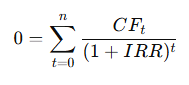
Where:
CFt = cash flow at time t
n = number of periods
Because this equation cannot be rearranged algebraically in most real-world cases, IRR is typically solved using:
Trial and error
Financial calculators
Iterative numerical methods (such as Newton-Raphson)
For XIRR, the formula becomes:
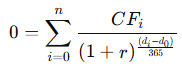
This adjusts the discounting based on actual day counts, which is why XIRR is considered more precise for investment modelling.
IRR vs Required Return (Discount Rate) in Valuations
A common misunderstanding is that IRR and the required return (or discount rate) are the same. In reality, they serve very different purposes.
IRR
A performance metric
Calculated after forecasting cash flows
Represents the investment’s implied annual return
Required Return / Discount Rate
A valuation assumption
Set based on risk, market conditions, leverage, and opportunity cost
Used to discount projected cash flows to determine present value
In investment decision-making:
If IRR > required return, the project may create value
If IRR < required return, the investment may destroy value
Therefore, IRR is often compared against:
Cost of capital
Hurdle rate
Target equity return
This comparison helps investors assess whether they are being adequately compensated for risk.
Advantages of IRR
✅ Incorporates the time value of money
✅ Enables comparison across different investments
✅ Reflects both income yield and capital growth
✅ Widely understood by lenders, investors and analysts
Limitations of IRR
Despite its usefulness, IRR has important drawbacks:
⚠️ Ignores investment scale - a smaller project can produce a higher IRR but lower absolute profit
⚠️ Sensitive to exit assumptions - small changes in sale price or timing can significantly impact IRR
⚠️ Multiple IRRs can occur if cash flows change sign more than once
⚠️ Assumes reinvestment at the IRR, which may be unrealistic
For this reason, IRR should be analysed alongside other metrics such as:
Equity multiple
Net present value (NPV)
Cash-on-cash return
Risk-adjusted return measures
Final Thoughts
IRR remains one of the most important tools in real estate investment analysis because it provides a standardised measure of annualised performance. However, sophisticated investors understand that it should never be used in isolation.
A robust investment decision requires:
Sensitivity analysis
Market due diligence
Financing considerations
Comparison to required return thresholds
When used correctly - particularly with tools like XIRR for irregular cash flows — IRR can offer powerful insight into how effectively capital is being deployed and compounded over time.
Want to master how to calculate and use the IRR formula in Excel like a real estate investment professional?
Join the EIP Academy to learn practical financial modelling skills, including how to build IRR and XIRR calculations, interpret returns, and apply them confidently in real-world property deals.
