Development Finance: How Rolled-Up Interest Works
Development Finance: How Rolled-Up Interest Works
With development finance, the lender pays out money in stages as the build moves along. These stages are called drawdowns. The interest is usually added to the loan (rolled up) rather than paid monthly, and it is all repaid when the scheme is sold or refinanced. Because you end up paying interest on interest, it costs a bit more than a simple calculation suggests.
The quick version
Lenders release money in stages as costs are incurred, so you only pay interest on what has been drawn.
Rolled-up interest is added to the loan balance, so it compounds.
Model it with four lines: opening balance, drawdown, interest and closing balance.
Don't forget fees: arrangement, commitment (on undrawn money) and exit fees.
How does development finance work?
A development loan funds a scheme in phases. The lender may advance part of the land purchase at the start, then release money against build costs as work is completed. Each drawdown starts earning interest on the day it is drawn. The loan is repaid when the scheme is sold, or when you refinance onto longer-term debt once the building is let.
What is rolled-up interest?
Instead of paying interest each month, the interest is added to the loan, and next period's interest is charged on the bigger balance. Here is an example: £4,000,000 drawn in four equal quarterly drawdowns, with interest at 8% a year (2% a quarter), over a four-quarter build and two more quarters of letting.
Quarter | Drawdown | Interest at 2% | Closing balance |
|---|---|---|---|
1 | £1,000,000 | £20,000 | £1,020,000 |
2 | £1,000,000 | £40,400 | £2,060,400 |
3 | £1,000,000 | £61,208 | £3,121,608 |
4 | £1,000,000 | £82,432 | £4,204,040 |
5 | none | £84,081 | £4,288,121 |
6 | none | £85,762 | £4,373,883 |
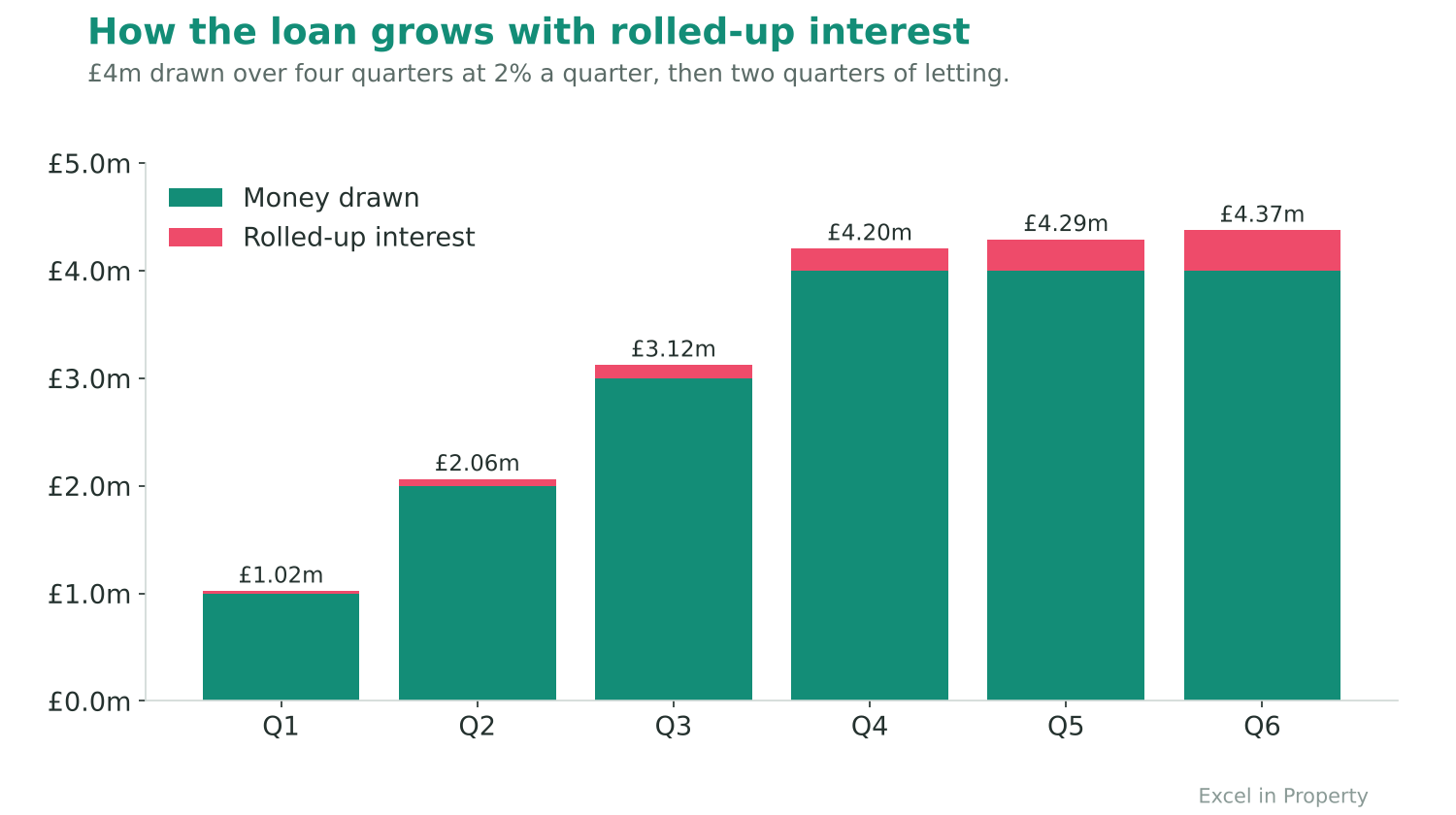
Total rolled-up interest is £373,883. If the same interest were paid each quarter instead of being added to the loan, it would be £360,000. The difference of £13,883 is the cost of compounding. Add a 1% arrangement fee (£40,000) and the total finance cost is £413,883.
Which fees do you need to model?
Arrangement fee: paid to the lender for setting up the loan, usually a percentage of the facility.
Commitment fee: charged on money the lender has agreed to lend but you have not yet drawn.
Exit fee: charged when the loan is repaid.
Margin: the lender's spread over a reference rate such as SONIA. See our guide to key debt terms.
What are loan to cost and loan to GDV?
Loan to cost (LTC) is the loan divided by total project cost. Loan to GDV (LTGDV) is the loan divided by the value of the finished scheme. For example, a £4,000,000 loan on a project costing £6,000,000 is 66.7% LTC, and on a GDV of £10,000,000 it is 40% LTGDV.
How do you model it in Excel?
Create a timeline across the top (months or quarters).
Row 1: opening balance (last period's closing balance).
Row 2: drawdown, linked to your cost schedule.
Row 3: interest = (opening balance + drawdown) × annual rate ÷ periods per year. This assumes drawdowns happen at the start of the period.
Row 4: closing balance = opening balance + drawdown + interest.
Add fee lines, a repayment at sale or refinance, and a check that the loan is repaid in full.
Straight-line or S-curve drawdowns?
Spending on a build usually follows an S-curve: slow at the start, fastest in the middle and slower at the end. A straight-line profile spreads the same total evenly. Because interest is charged on what has been drawn, the shape changes the cost.
Take the same £4,000,000 over four quarters at 2% a quarter, with two quarters of letting afterwards. Drawn in four equal amounts, rolled-up interest is £373,883. Drawn on an S-curve (£400,000, £1,200,000, £1,600,000 and £800,000), it is £356,220. That is £17,664 less, because less money is borrowed for less time early on. So match your drawdowns to your real cost programme, rather than just spreading costs evenly.
What happens at refinance?
Once the building is let, a new investment loan can repay the development loan. In the model, the new loan is drawn on one date and the development loan is repaid on the same date. Check that the new loan passes the lender's tests on value and income. See how to model a property loan.
Who pays first, the developer or the lender?
Many lenders expect your equity to go in first, then the loan is drawn. That delays interest and reduces it. Others fund in proportion to equity (pari passu). Check the term sheet, because the order changes both your interest cost and your peak equity.
What should you look for in a facility?
The facility amount and the limits on loan to cost and loan to GDV
The term, and any extension options and fees
The margin and reference rate, and whether interest is rolled up or paid
Arrangement, commitment and exit fees
Covenants, security and the conditions for each drawdown
Frequently asked questions
Is development finance interest compounded?
When interest is rolled up, yes. It is added to the balance each period, so later interest is charged on earlier interest.
What is a commitment fee?
A fee on the undrawn part of a facility, paid because the lender is keeping that money available for you.
What interest rate should I use?
Use a reference rate such as SONIA plus the lender's margin, taken from a quote or term sheet. Rates change, so check the current position before relying on any example.
Want to learn how to do this properly?
The Debt and Financing for Real Estate course covers drawdowns, rolled-up costs, fees and refinancing. The How to Model a Development course shows how finance fits into a full appraisal.
Join the EiP Academy for all nine courses
