Beyond the Black Box: A Practitioner’s Guide to the RICS DCF Guidance
Beyond the Black Box: A Practitioner’s Guide to the RICS DCF Guidance
For years, real estate valuation in the UK has leaned heavily on "All-Risks Yield" (ARY) and static residual appraisals. But as the market becomes more complex – influenced by fluctuating ESG requirements, erratic inflation, and sophisticated investor business plans – the industry is reaching a turning point.
In November 2023, RICS issued updated guidance on Discounted Cash Flow (DCF) for valuations. As the author of the RICS iSurv guidance and the founder of EiP, I’ve seen first-hand the gap between reading a guidance paper and actually building a model that holds up under scrutiny.
In this post, we’ll break down the core of the RICS DCF standards and explain why your financial modelling skills are now your most valuable asset.
Why DCF? Why Now?
Traditionally, the "high number of input variables" in a DCF made valuers nervous. It felt subjective. However, a DCF allows for a level of precision that a static yield simply cannot capture.
According to the RICS guidance, DCF is particularly appropriate when:
The asset is complex: Think retail parks with multiple lease lengths or office buildings requiring significant ESG–related capex.
The timeline is long: For large–scale developments where time–value of money is critical.
The market demands it: Purchasers are using DCFs to make decisions; therefore, valuers must use them to reflect Market Value.
The Core Formula: Reality vs. Theory
Mathematically, the guidance defines DCF as the sum of projected cash flows (CF) discounted by a target rate (r):
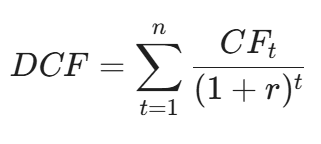
But in the "Commercial Reality" of a property deal, the formula is only as good as your inputs. The guidance highlights three critical areas where professionals often stumble:
1. Explicit vs. Implicit Growth
Explicit: You forecast actual inflation, rent reviews, and cost increases (e.g., CPI/RPI) into every period.
Implicit: You keep the cash flow in today's values and reflect growth within the capitalisation rate.
The EiP Take: We always advocate for explicit modelling. It forces you to think critically about market trends rather than hiding assumptions inside a yield.
2. The "Exit" Logic
The Exit Value (or Terminal Value) is often where the most value is "created" in a model. The guidance notes that you must adjust your Gross Sale Value for:
Rent–free periods remaining at the point of sale.
Purchaser’s and Seller’s costs.
Capital expenditure (Capex) required to keep the building let–able (especially for EPC B compliance).
3. The Discount Rate (r)
For an investor, this is the Target Return (IRR). For a Valuer, this must reflect the wider market. You can derive this from government bonds, long–term yield trends, or transactional evidence.
The Problem with "Black Box" Software
The iSurv guidance specifically mentions a variety of software, from Argus to Forbury. While these tools have their place, they share a common flaw: they are "black boxes." As noted in the guidance:
"It’s important to have a strong understanding of how DCFs work before relying on valuation software... In cases where an asset requires more detail or analysis... valuers should consider using Microsoft Excel."
When you rely solely on a software toggle, you lose the ability to spot errors or explain the "why" to a client. Precision comes from understanding the logic, not just the interface.
Valuation Software: Why Understanding the Logic Matters
From Theory to the Analyst’s Desk
The RICS paper provides the framework, but the EiP Academy provides the execution.
Whether you are valuing a portfolio of leasehold ground rents or a 45,000 sq ft office development, you need the "financial capability" to build these models from scratch. Understanding the RPI–linked uplifts in a lease or the sensitivity of a development’s land value to a 1% change in the discount rate is what separates a technician from a leader.
Master the DCF with EiP
Ready to bridge the gap between academic theory and real–world investment? The EiP Academy offers all–access training on the exact DCF methodologies used in the RICS guidance.
Explore the EiP Academy – All Access Financial Modelling
Frequently Asked Questions about RICS DCF Valuations
Q: When is a Discounted Cash Flow (DCF) more appropriate than an All-Risks Yield (ARY) valuation?
A: DCF is preferred for complex assets with varying lease lengths, significant upcoming capex (such as ESG upgrades), or longer-term development phasing. While ARY provides a static snapshot, a DCF allows the valuer to explicitly model the timing of cash flows, providing a more detailed and analytical estimate of market value.
Q: How does the RICS guidance distinguish between "Investment Value" and "Market Value" in a DCF?
A: Investment Value (or Worth) reflects the specific strategy and target return (IRR) of an individual investor. Market Value, however, must be based on what a willing buyer and seller would agree upon in an arm’s length transaction, requiring all inputs - including the discount rate - to be supported by objective market evidence.
Q: Should I use an explicit or implicit DCF model?
A: An explicit DCF incorporates actual expected growth, such as RPI/CPI rent reviews or forecasted cost increases, directly into each period of the cash flow. An implicit model keeps the cash flow in today’s values and accounts for growth within the capitalisation rate. The RICS guidance allows both, provided the valuer can justify their choice and the supporting data.
Q: Can I use Excel instead of specialist valuation software for RICS compliance?
A: Yes. The RICS guidance emphasises that understanding the underlying logic of a DCF is more important than the software used. While "black box" tools are common, Microsoft Excel is often preferred for complex assets that require greater flexibility and transparent calculations that are easily audited.
