What Is GDV in Property? How to Calculate It
What Is GDV in Property? How to Calculate It
Gross development value, or GDV, is what a development will be worth once it is finished and sold or let. It is the top line of every development appraisal, and it drives both the land price you can pay and the loan a lender will offer. Here are the three ways to work it out, with examples.
The quick version
GDV is the value of the completed scheme, not the value of the site today.
You can work it out from rent and yield (commercial), unit prices (residential) or a price per square foot.
Take purchaser's costs off GDV and you get net development value (NDV).
Lenders use GDV to set loan limits, often as a loan to GDV ratio.
What does GDV mean?
GDV is the total value of the scheme when it is complete. Every unit is sold at its expected price, or every unit is let and valued on its income, and the lot is added together. It is "gross" because no costs have been taken off yet. Valuers often give it as a "special assumption", which means "the value as if the scheme were already built".
How do you calculate GDV?
There are three common methods. Which one you use depends on the scheme.
Method | Best for | Example | GDV |
|---|---|---|---|
Yield method | Commercial schemes valued on income | £600,000 rent ÷ 6.0% yield | £10,000,000 |
Unit method | Residential schemes with different unit types | 12 flats × £425,000 | £5,100,000 |
Price per sq ft method | Residential or commercial sales | 10,500 sq ft × £485 per sq ft | £5,092,500 |
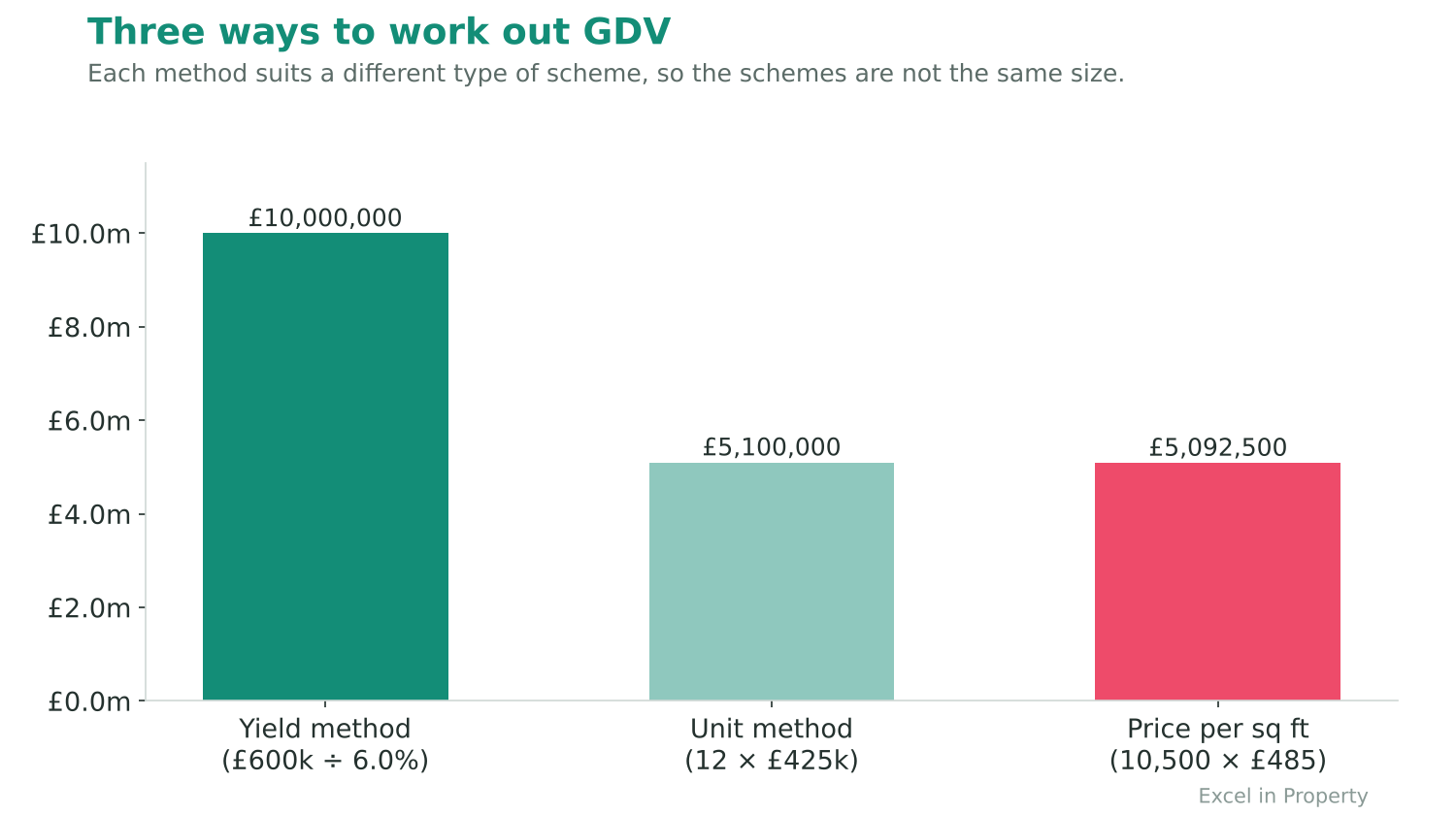
These are three different example schemes, so the point is how each calculation works, not which is biggest.
Mixed-use schemes
For a mixed-use scheme, value each part with its own method and add them together. For example, £5,100,000 of flats plus a ground floor shop let at £90,000 a year and valued at 6.5% (£1,384,615) gives a GDV of £6,484,615.
GDV or NDV?
When someone buys the finished scheme, they pay purchaser's costs (SDLT, agent and legal fees) on top of the price. Net development value (NDV) is GDV after those costs. With the usual UK assumption of 6.8%, a GDV of £10,000,000 becomes an NDV of £9,363,296 (£10,000,000 ÷ 1.068). Always say which figure you mean.
Is GDV the same as market value?
No. Market value is what a property is worth today, as it is. GDV is what the scheme is expected to be worth when finished, based on market evidence at the valuation date. For more on how valuers think about price and value, see our guide to value versus worth.
How do lenders use GDV?
Lenders compare the loan with GDV using the loan to GDV ratio (LTGDV). A £6,000,000 loan against a GDV of £10,000,000 is 60% of GDV. They also look at loan to cost (LTC), which is the loan divided by the total project cost.
Where do your numbers come from?
Use evidence you can point to: recent sales of similar property, recent lettings, and yields from comparable deals. Be careful with asking prices, which are often higher than the prices achieved. When you value on rent, allow for incentives such as rent-free periods.
Worked example: from floor area to NDV in five steps
Measure the lettable area: 20,000 sq ft of net internal area.
Estimate the rent from comparable lettings: £30 per sq ft, so £600,000 a year.
Choose a yield from comparable sales: 6.0%.
Divide: £600,000 ÷ 6.0% = £10,000,000 GDV.
Take off purchaser's costs of 6.8%: £10,000,000 ÷ 1.068 = £9,363,296 NDV.
Half a point on the yield matters. At 6.5%, GDV is £9,230,769, which is about £770,000 lower. That is why yield evidence deserves the most care.
What moves GDV the most?
Yield: a small change in yield changes value a lot.
Rent and incentives: a rent-free period lowers the effective rent a buyer will pay for.
Timing: GDV is usually set on today's evidence, even if the sale is years away.
Specification and efficiency: the ratio of lettable to total area changes the rent the building can earn.
Planning: the permitted use and density change what the scheme can be worth.
Common GDV mistakes
Using asking prices instead of achieved prices.
Ignoring rent-free periods and other incentives.
Using gross area where the method needs net area.
Forgetting purchaser's costs, so the appraisal looks better than it is.
Using an optimistic yield and not testing it. See how to do a development appraisal.
Frequently asked questions
What does GDV stand for?
Gross development value: the estimated value of a completed scheme before development costs are taken off.
Is GDV the same as profit?
No. GDV is the top line. Profit is what is left after all costs, including land and finance.
How do you calculate GDV for a commercial building?
Divide the expected annual rent by the yield. For example, £600,000 ÷ 6.0% = £10,000,000. Then take off purchaser's costs to reach NDV.
Want to learn how to do this properly?
In the How to Model a Development: From Residual to DCF course, you calculate GDV using the yield, unit and price per square foot methods, then carry it all the way through to profit and land value.
Join the EiP Academy for all nine courses
New to modelling? Start with the Crash Course
