Residual Land Value: What It Is and How to Calculate It
Residual Land Value: What It Is and How to Calculate It
Residual land value is the most you can pay for a site and still make the profit you need. You work it out by taking the value of the finished scheme and taking off the costs and the profit. What is left is the land. Let's walk through the formula, a worked example, and why land value is so sensitive.
The quick version
Residual land value = GDV, less sales costs, build costs, fees, contingency, finance and profit, then adjusted for the costs of buying the land.
Land is the balancing figure, so small changes in value or cost move it a lot.
A residual appraisal is a quick snapshot. A DCF shows timing and finance more accurately.
The profit measure you choose, on GDV or on cost, changes the answer.
What is residual land value?
It is the value of development land worked out from what the finished scheme is worth, rather than from what neighbouring plots sold for. It is the most common way to value land with development potential, because it takes account of the costs of the particular site and scheme.
What is the formula?
Start with GDV and work down:
Take off sales or purchaser's costs.
Take off construction costs, professional fees and contingency.
Take off finance costs.
Take off the developer's profit.
What remains is the amount available for the land and the costs of buying it.
Divide by one plus the land costs (SDLT, agent and legal fees) to find the price you can pay.
Residual land value example
A small residential scheme. All figures are illustrative.
Line | Working | Amount |
|---|---|---|
GDV | £6,000,000 | |
Sales costs | 3% of GDV | (£180,000) |
Construction | (£2,400,000) | |
Professional fees | 10% of construction | (£240,000) |
Contingency | 5% of construction | (£120,000) |
Finance | (£250,000) | |
Developer's profit | 20% of GDV | (£1,200,000) |
Left for land and land costs | £1,610,000 | |
Residual land value | £1,610,000 ÷ 1.065 (6.5% land costs) | £1,511,737 |
Why is residual land value so sensitive?
Because land is what is left over. Change GDV by 5% and the land value moves by almost three times as much.
GDV | Residual land value | Change in land value |
|---|---|---|
£5,700,000 (down 5%) | £1,294,836 | down 14.3% |
£6,000,000 (base) | £1,511,737 | base |
£6,300,000 (up 5%) | £1,728,638 | up 14.3% |
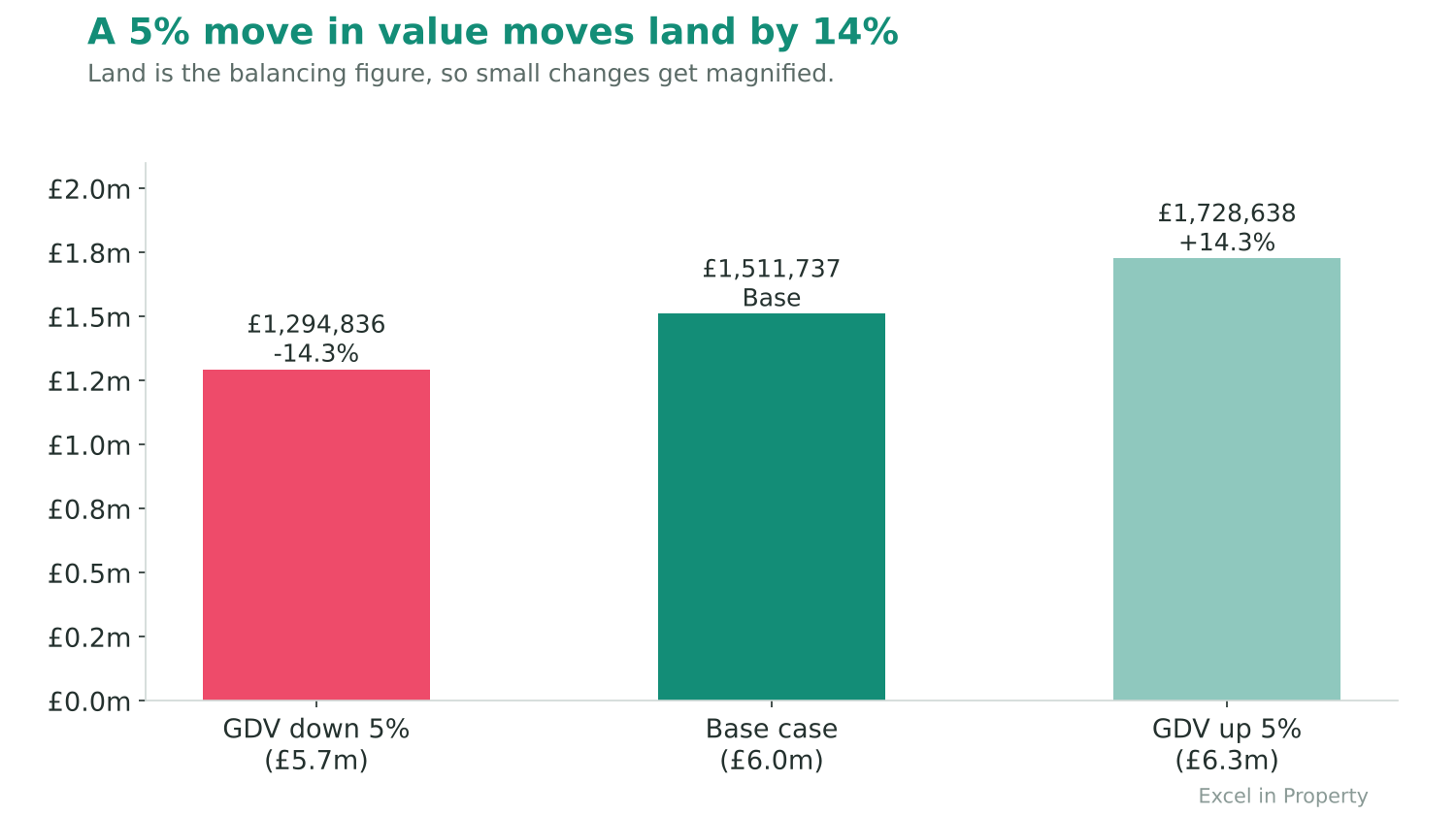
This is why buyers and sellers argue so hard over small differences in value, and why you should always run sensitivities. Here is how to do a sensitivity analysis.
Residual valuation or DCF?
A residual valuation uses a simple timeline and one finance figure. A development DCF models cash flows over time, including drawdowns, the letting period and the exit. Use the residual to find a land price quickly, then test it with a DCF. Our guide to DCF in real estate covers when to use one.
What profit should you use?
Use the measure and level your funder or investment committee uses, and say clearly whether it is on GDV or on cost. In UK planning viability work, the residual land value is often compared with a benchmark land value to decide whether a scheme can afford its planning obligations.
How do you calculate it in Excel?
Put each line in its own row, with the percentages as inputs. Then solve for land with one formula. If land costs and land interest are percentages of the land price:
land price = value left after costs and profit ÷ (1 + land costs % + land interest %)
In the example above the formula is =1610000/(1+0.065). If your land costs depend on the price in bands, as SDLT does, use Goal Seek to find the land price that makes the profit equal your target.
What else changes what a buyer will pay?
Planning risk: land without consent is worth less than land with it.
Abnormal costs: contamination, utilities and ground conditions.
Competition: other bidders may use different assumptions.
Timing and finance: a slower programme costs more interest.
Funder requirements: a lender may need a higher profit margin.
That is why residual land value is a ceiling, not a price. Buyers usually bid below it to leave room for risk.
A quick checklist
Is GDV based on achieved prices, not asking prices?
Have you included contingency?
Have you included interest on the land?
Is your profit measure the same one your target uses?
Have you tested GDV and build cost up and down by 5%?
Common mistakes
Forgetting land costs (SDLT, agent and legal fees) when quoting the price.
Leaving out interest on the land.
Using a profit target on one basis and reporting on another.
Not testing value and cost sensitivities.
Frequently asked questions
What is a residual valuation?
It values land by taking the value of the completed development and subtracting the costs of building it and the developer's profit.
Why does residual land value change so much?
Because it is the balancing figure. A small percentage change in GDV or build cost is a much bigger percentage of what is left for the land.
Is residual land value the same as market value?
Not always. Residual land value is a calculation for one specific scheme. Market value is the price a buyer would pay in the open market, which also reflects what other buyers could do with the site.
Want to learn how to do this properly?
The How to Model a Development: From Residual to DCF course shows you the whole process. The Complete Guide to Property Valuations course puts the residual method into the wider valuation picture.
Join the EiP Academy for all nine courses
