Property Valuation Methods Explained: Which to Use and When
Property Valuation Methods Explained: Which to Use and When
The main ways to value property are comparable evidence, income capitalisation (the investment method), residual, discounted cash flow (DCF) and cost. Which one a valuer uses depends on the property and the information available. Here is what each one does and when to reach for it.
The quick version
Most methods fall into two groups: implicit (one yield carries the assumptions) and explicit (you model the cash flows).
Use comparable evidence when similar properties have sold recently, and income methods for investment property.
Use the residual method for development land and DCF for complex or changing income.
Valuers following RICS standards must use methods that meet the Red Book and international standards.
What are the main methods?
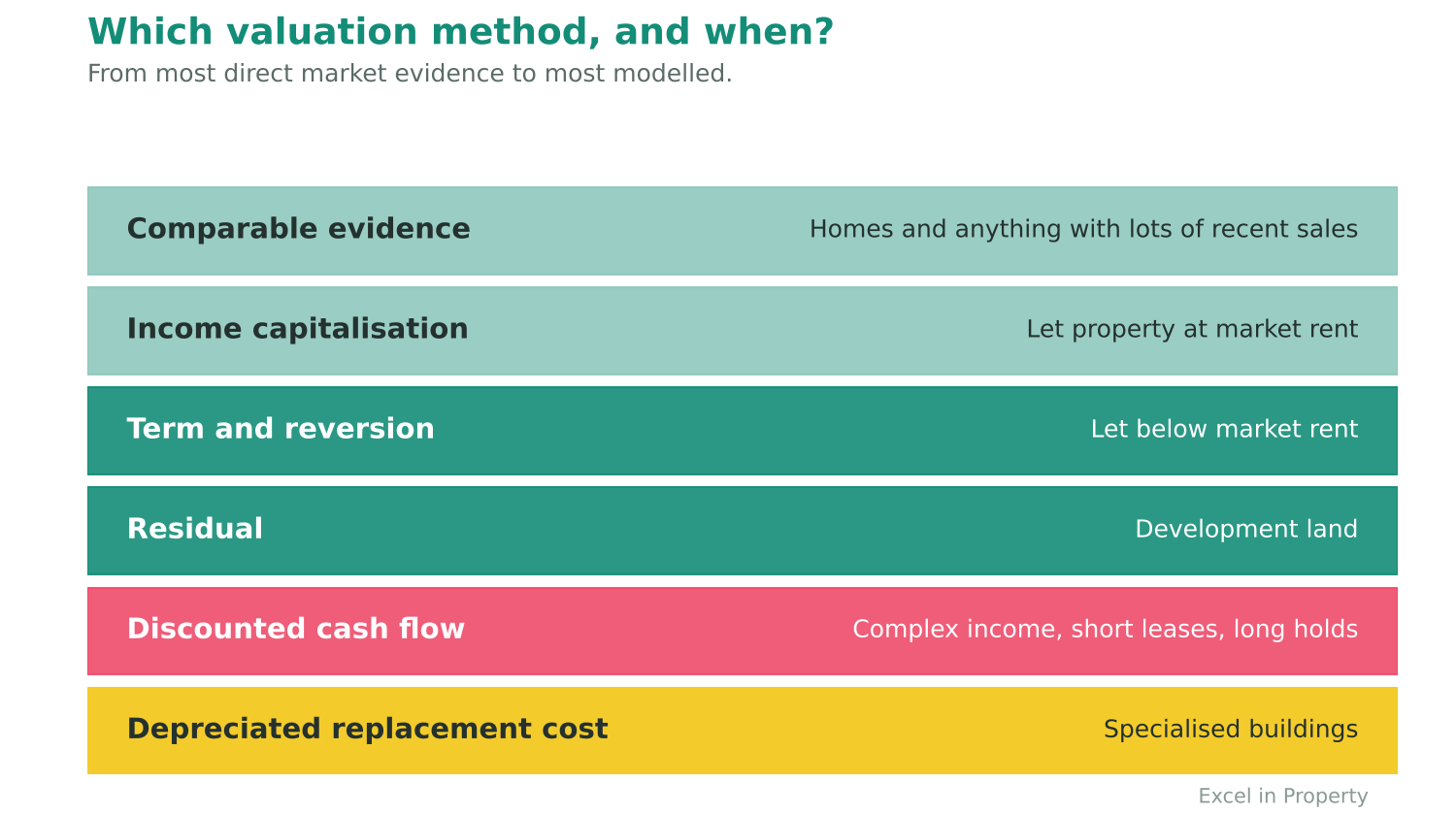
Method | What it does | Best for |
|---|---|---|
Comparable (market evidence) | Compares the property with similar ones that have sold or let | Homes, and property with plenty of recent evidence |
Income capitalisation | Divides rent by a yield (or multiplies by a years' purchase figure) | Let property where rent is at market level |
Term and reversion | Values the current rent for its term, then the higher market rent after | Property let below market rent |
Hardcore and top-slice | Splits income into a secure layer and a riskier top layer | Property let below or above market rent |
Residual | Takes the value of the finished scheme, then subtracts costs and profit | Development land |
Discounted cash flow (DCF) | Forecasts the cash flows and discounts them to today | Complex income, short leases, long hold periods |
Depreciated replacement cost | Estimates the cost to rebuild, less depreciation | Specialised property with few comparables |
There are others too, such as the profits method for trading properties like hotels, which values the business income rather than the rent.
Implicit or explicit?
Implicit methods use one yield or multiplier that has the assumptions about growth and risk built in. Income capitalisation is the classic example. For a rent of £40,000 and a yield of 7%, the gross value is £40,000 ÷ 7% = £571,429. Take off 6.8% purchaser's costs and the market value is about £535,045.
Explicit methods list the assumptions one by one: rent, growth, costs, timing, exit value and a discount rate. DCF is the main example. It takes more work, but you can see exactly what you have assumed. For more detail see our guides to implicit valuation models and DCF in real estate.
How do valuers choose a method?
They start with the best evidence available and the purpose of the valuation. Where there are good comparable transactions, those carry the most weight. Where there aren't, they move to methods that model the income or the development. Valuers working to RICS standards follow the RICS Red Book and the International Valuation Standards, which set out how valuations must be carried out and reported. It also helps to understand the difference between price, value and worth. See value versus worth.
Where do the inputs come from?
Yields come from recent transactions of similar property. Rents come from recent lettings and the current tenants' leases. Costs come from quotes and benchmarks. Whatever the source, keep a note of it, because a valuation is only as good as the evidence behind it.
Term and reversion: a worked example
Use this method when a property is let below market rent. A shop is let at £40,000 a year for three more years, then the rent should rise to the market rent of £45,000. The yield is 7%.
Value the term: £40,000 × the years' purchase for three years at 7% (2.6243) = £104,973.
Value the reversion: £45,000 ÷ 7% = £642,857 in perpetuity, then bring it back three years: £642,857 × 0.8163 = £524,763.
Add them: £104,973 + £524,763 = £629,736. Divide by 1.068 for purchaser's costs and the value is about £589,640.
If you ignored the rise and simply capitalised £40,000 at 7%, the value would be £535,045. The reversion adds about £55,000.
Which method suits which property?
Office let at market rent on a normal lease: income capitalisation.
Shop let below market rent: term and reversion.
Development site: residual.
Irregular income, short leases or a long hold: discounted cash flow.
Specialised building with few comparables: depreciated replacement cost.
Houses and flats: comparable evidence.
Working towards your APC?
If you are heading for the RICS Assessment of Professional Competence (APC), you need to explain each method, know when it applies and justify your inputs. Practise with simple numbers first, then move on to cash flows.
Frequently asked questions
What are the five methods of valuation?
Traditional UK textbooks list five: comparison, investment, profits, residual and cost. DCF is a technique within the investment approach.
Which valuation method is most accurate?
None is always the most accurate. The best method is the one that fits the property and has the strongest evidence behind it.
What is the difference between a yield and a discount rate?
A yield links one year's income to value and carries growth and risk assumptions inside it. A discount rate is used on forecast cash flows that already show growth explicitly.
Want to learn how to do this properly?
The Complete Guide to Property Valuations course covers every method above, the Red Book and when to use each one.
Join the EiP Academy for all nine courses
