What Is a Cap Rate? Formula, Example and UK Yield
What Is a Cap Rate? Formula, Example and UK Yield
A cap rate (capitalisation rate) is a property's net operating income divided by its price. It tells you the income return before any debt, which makes it a quick way to compare properties. "Cap rate" is the term you will hear in the US. In the UK we usually talk about yields, and the closest one is the net initial yield, which also counts purchaser's costs. We will cover both.
The quick version
Cap rate = net operating income (NOI) ÷ property price.
NOI is the rent minus the running costs the landlord cannot recover. It leaves out loan payments.
A UK net initial yield divides by the price plus purchaser's costs, so it comes out lower than the cap rate.
A small change in the cap rate changes value a lot.
What is a cap rate?
It shows the annual income a property produces as a percentage of what you pay for it. It ignores how the purchase is financed, which makes it handy for comparing properties like for like. Valuers use the same idea in reverse: divide the income by a market yield to estimate value. See our guide to implicit valuation models.
What is the formula?
Cap rate = net operating income ÷ property price
Net operating income (NOI) is the income after the running costs the landlord cannot pass on to tenants, such as non-recoverable management, insurance or repairs. It leaves out loan interest, tax and depreciation, and is usually shown before major capital spending.
Cap rate example
Line | Amount |
|---|---|
Price | £5,000,000 |
Annual rent | £330,000 |
Non-recoverable costs | (£10,000) |
Net operating income | £320,000 |
Cap rate | £320,000 ÷ £5,000,000 = 6.4% |
Cap rate or UK yield?
In UK practice you will mostly hear "yield". The most common is the net initial yield (NIY), which is net rent divided by the price plus purchaser's costs. With purchaser's costs of 6.8%, the buyer's total cost in our example is £5,340,000.
Measure | Working | Result |
|---|---|---|
Cap rate | £320,000 ÷ £5,000,000 | 6.4% |
Net initial yield | £320,000 ÷ £5,340,000 | 6.0% |
Two other yields come up a lot. The reversionary yield uses the market rent the property could earn in future instead of today's rent. The equivalent yield is a blended yield that reflects both the current and the reversionary rent. Always check which yield a number refers to before you compare.
What is a good cap rate?
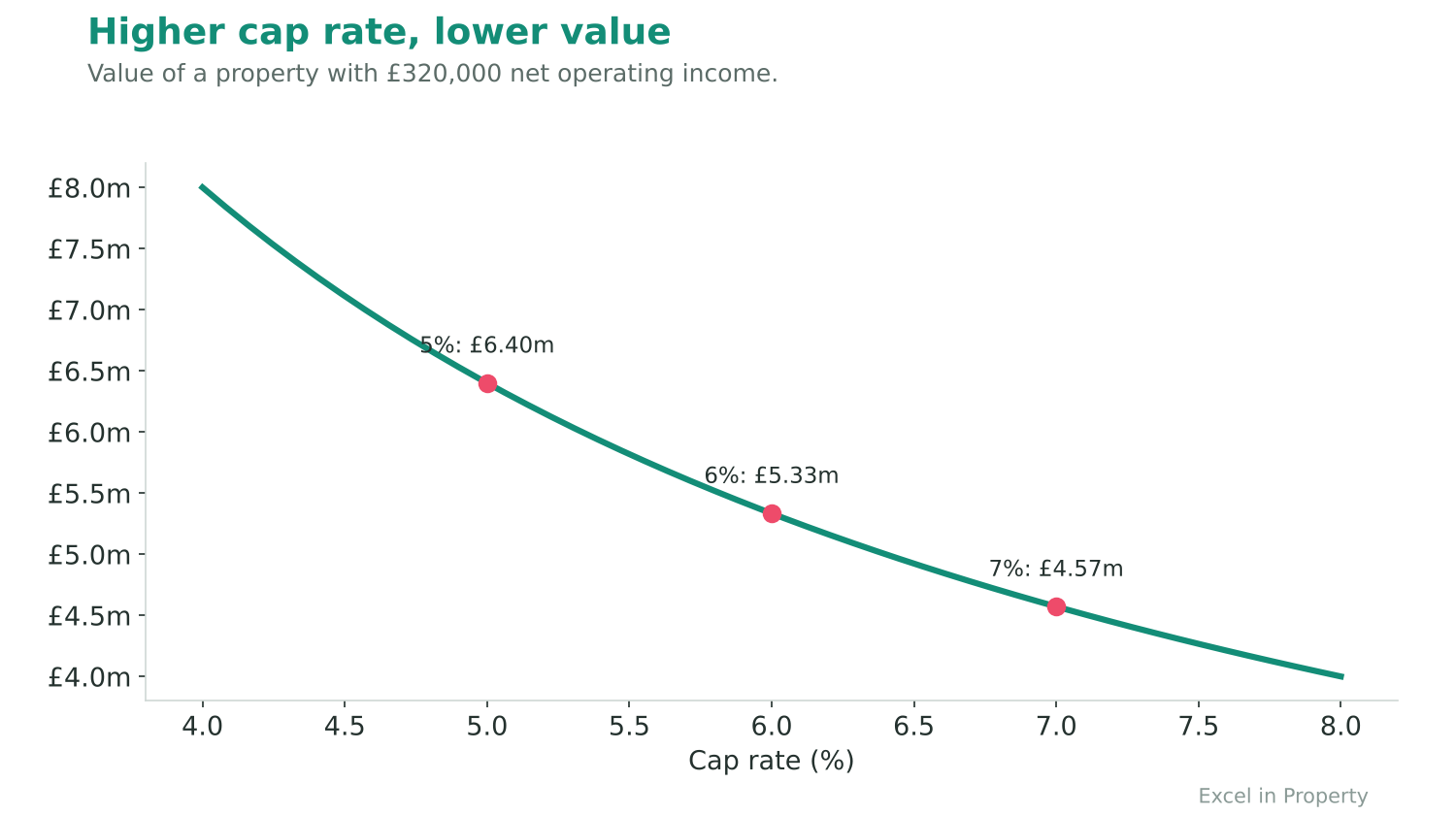
There is no single good number. It depends on how secure the income is (tenant quality and lease length), the location and type of property, expected rent growth and interest rates. A lower cap rate usually means lower risk or higher growth, and a higher one usually means more risk or lower growth. Here is what a change does to value, using NOI of £320,000.
Cap rate | Value |
|---|---|
5.0% | £6,400,000 |
6.0% | £5,333,333 |
7.0% | £4,571,429 |
How do you calculate it in Excel?
Put NOI in one cell and the price in another, then divide: =NOI/Price. Format the answer as a percentage. For a UK yield, divide by the price multiplied by (1 + purchaser's costs).
How do you value a property using a cap rate?
Turn the formula around: value = NOI ÷ cap rate. With NOI of £320,000 and a cap rate of 6.4%, the value is £5,000,000.
In UK practice you divide the net income by a net initial yield, then take off purchaser's costs. At a net initial yield of 6.0%, £320,000 ÷ 6.0% = £5,333,333. Divide by 1.068 and the net value is £4,993,758. The yield you use must be the same type as the evidence it came from.
How do yields relate to interest rates?
When borrowing costs and the return on safe investments such as gilts go up, investors usually want a higher income return from property. Yields tend to rise and values tend to fall. The link is not one for one, because it also depends on rent growth expectations, the tenant, the lease length and how many buyers there are. The same 6% looks generous when safe investments pay 2%, and thin when they pay 5%.
How is a cap rate different from IRR?
A cap rate is one year's income against the price. IRR looks at all the cash flows over the whole hold, including growth and the sale. A property bought on a 6% yield with good rent growth can deliver an IRR above 6%. See our guide to IRR.
Common mistakes
Using gross rent instead of NOI.
Ignoring void periods or rent-free periods in the income.
Comparing a cap rate (without costs) with a net initial yield (with costs).
Comparing properties with very different lease lengths or tenant risk as if they were equal.
Frequently asked questions
Is a higher cap rate better?
A higher cap rate means more income for the price, but it usually reflects higher risk or lower growth. It is not automatically better.
What is the difference between cap rate and ROI?
A cap rate looks at one year's income against the price and ignores financing. Return on investment looks at the total return over time, including growth and borrowing.
What is NOI in real estate?
Net operating income is the property's income less the operating costs the landlord has to pay, before loan payments, tax and depreciation.
Want to learn how to do this properly?
The Complete Guide to Property Valuations course covers income capitalisation, yields and the other valuation methods used in the UK. If you are new to modelling, the Crash Course explains NOI and returns from scratch.
Join the EiP Academy for all nine courses
