
Real Estate Financial Modelling Test: How to Pass It
Real Estate Financial Modelling Test: How to Pass It
A real estate financial modelling test is a timed Excel task, set by an employer, to see whether you can build a clear, accurate model from a set of assumptions and explain the result. To pass, plan your time, keep your model tidy, check your numbers and finish with a short summary of what you recommend. Here is how.
The quick version
Employers test accuracy, structure, clarity and commercial judgement, not just Excel skills.
Spend a few minutes planning, and leave time at the end for checks and a summary.
Keep inputs, calculations and outputs separate, and don't type numbers into formulas.
Practise full mock tests against the clock.
What is a modelling test?
You are given a pack, often a tenancy schedule, some assumptions and sometimes a development scenario. You are asked to build a cash flow, work out returns such as IRR and equity multiple, and answer questions or write a short paper. Tests can be taken in the office or at home, and usually last from one to a few hours. Many UK agents, funds, developers and lenders use them, and some are followed by an interview where you explain your work.
What do employers look for?
Accuracy: the numbers are right and the model balances.
Structure: inputs, calculations and outputs are separate and easy to follow.
Clarity: labels, units and assumptions are clear.
Judgement: you flag risks and say what you would do.
Time management: you finish, and you leave time to review.
How do you prepare?
Learn the core Excel functions until you rarely need to look them up. Our Excel shortcuts guide helps with speed.
Learn the standard investment model: tenancy schedule, cash flow, purchase, sale and returns.
Practise a development appraisal too, as some tests include one. See how to do a development appraisal.
Do full mock tests against the clock, then review what you got wrong.
Practise explaining your result in two or three sentences.
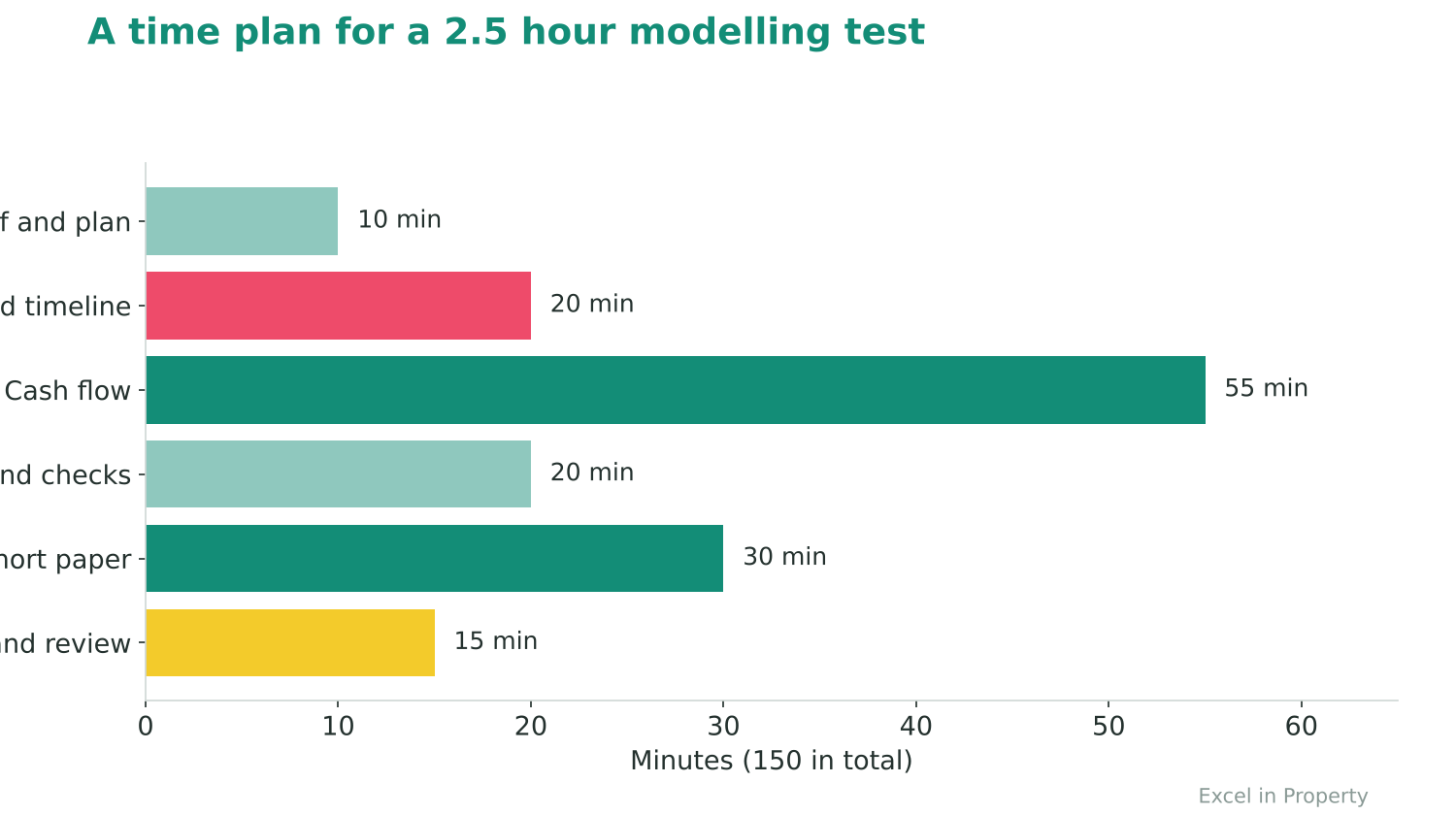
A sample time plan for a 2.5-hour test
Stage | Time |
|---|---|
Read the brief and plan the layout | 10 minutes |
Inputs and timeline | 20 minutes |
Cash flow | 55 minutes |
Returns and checks | 20 minutes |
Summary or short paper | 30 minutes |
Buffer and final review | 15 minutes |
10 tips to pass
Read the whole brief before you touch Excel.
Write down your assumptions as you go.
Put every input in one place, and never type numbers into formulas.
Keep one formula per row, copied across, so the model is consistent.
Use clear labels and units on every line.
Be careful with signs: money out is negative, money in is positive.
Add checks, such as totals that must match.
Don't build more than the test asks for.
Leave time for a one-page summary with your recommendation.
Keep it simple. A clear, correct model beats a clever, broken one.
What does a typical brief look like?
Here is the kind of brief you might see. It is an example, not a real test.
You are an analyst at a fund considering buying a multi-let office building. You have a tenancy schedule with six tenants, a purchase price, purchaser's costs, rental growth, void and letting assumptions and a debt term sheet. Build a ten-year cash flow, calculate unlevered and levered IRR and equity multiple, and prepare a one-page summary for the investment committee with your recommendation.
A good answer builds the tenancy schedule first, then the cash flow, then returns, then checks.
What does a good summary look like?
It should fit on one page and answer four questions: what is the deal, what are the returns, what are the main risks, and what do you recommend? Here is an example only.
We recommend proceeding at £10.0m. The building is 92% let with a WAULT of 4.7 years, and the unlevered IRR of 7.1% rises to 9.4% with 60% debt. The main risks are two breaks in year 3 and the exit yield: a 0.5% rise in the exit yield reduces the IRR by about 1.3 points. We recommend asking the seller for a rent-free contribution and testing the breaks before exchange.
Common mistakes
Running out of time before returns and the summary.
Typing numbers into formulas, so changing an assumption breaks the model.
Mixing up months and years in the timeline.
Not checking whether the answer is sensible.
Writing nothing in words. Your model should always come with a short explanation.
What about the interview?
Be ready to explain what the model does, the three or four assumptions that matter most, what the returns are and what could change your mind. A calm, short explanation shows judgement, which is often what separates two candidates with similar models. For more on what employers want, see our guide to the top skills employers look for in real estate finance roles, and read why you should never cheat on a modelling test.
If you get a question you can't answer, say what you would check and how. "I'm not sure, but I would test it by changing the exit yield and looking at the IRR" shows good judgement. A confident guess that turns out wrong doesn't.
Frequently asked questions
How long is a real estate modelling test?
It varies by employer, but one to a few hours is typical. Some are take-home. Check the instructions you are given.
Can I use my own template?
Check the rules for each test. Some allow it and some don't. Whatever the rules, make sure you can explain every line.
Which Excel functions do modelling tests use?
Common ones include SUMIFS, IF, INDEX and MATCH, EOMONTH and IRR or XIRR. The Excel Foundations course covers these.
Want to learn how to do this properly?
The How to Pass Modelling Tests and Interviews course includes mock tests, a time plan, a template for the investment committee paper, presentation skills and feedback options.
Explore the How to Pass Modelling Tests and Interviews course
Join the EiP Academy for all nine courses
New to modelling? Start with the Crash Course
