
Real Estate Waterfall: Promote and IRR Hurdles Explained
Real Estate Waterfall: Promote and IRR Hurdles Explained
A real estate waterfall is the order in which a deal's cash is paid out between the investors and the sponsor. Investors usually get their money back, plus a preferred return, first. After that the sponsor earns a bigger share of the profit, called the promote, once certain return hurdles are met. You will see waterfalls in UK joint ventures, club deals and funds. Here is how each part works, then a worked example.
The quick version
A waterfall decides who gets paid first, second and last when a deal produces cash.
Investors usually get their capital back and a preferred return before the sponsor earns a promote.
Hurdles are return levels, set as an IRR or an equity multiple, that trigger a bigger share for the sponsor.
The promote brings the investor's return below the project return.
What is a real estate waterfall?
Picture the deal's profit flowing down a series of pools. The first pool fills up first, and only when it is full does cash spill into the next one. Each pool is a tier with its own rules about who gets what. A waterfall model works out that split for every period.
What are the parts?
Equity contribution: the money the investors (and sometimes the sponsor) put in.
Return of capital: investors get their equity back.
Preferred return (pref): a minimum return paid to investors before the sponsor shares in profit, often compounding on unreturned capital.
Hurdle: a return level, such as a 12% IRR or a 1.8x equity multiple. Once investors reach it, the split changes. A hurdle can also combine both.
Promote: the sponsor's extra share of profit above the hurdle, on top of any share from their own equity.
Pari passu: sharing in proportion to the equity each party put in.
Catch-up: a tier that lets the sponsor catch up on profit after the pref is paid. Terms vary between deals.
Worked example
An investor puts in £1,000,000. The property is sold after three years for £1,600,000 of distributable cash, with no income in between to keep things simple. The terms are an 8% preferred return, then an 80/20 split until the investor reaches a 12% IRR, then 70/30.
Tier | Working | Investor | Sponsor |
|---|---|---|---|
1. Return of capital and 8% pref | £1,000,000 × 1.08³ = £1,259,712 | £1,259,712 | £0 |
2. 80/20 until investor reaches 12% IRR | Investor needs £1,000,000 × 1.12³ = £1,404,928, so £145,216 more. Total tier = £145,216 ÷ 0.8 = £181,520 | £145,216 | £36,304 |
3. 70/30 thereafter | £1,600,000 − £1,259,712 − £181,520 = £158,768 | £111,138 | £47,630 |
Total | £1,516,066 | £83,934 |
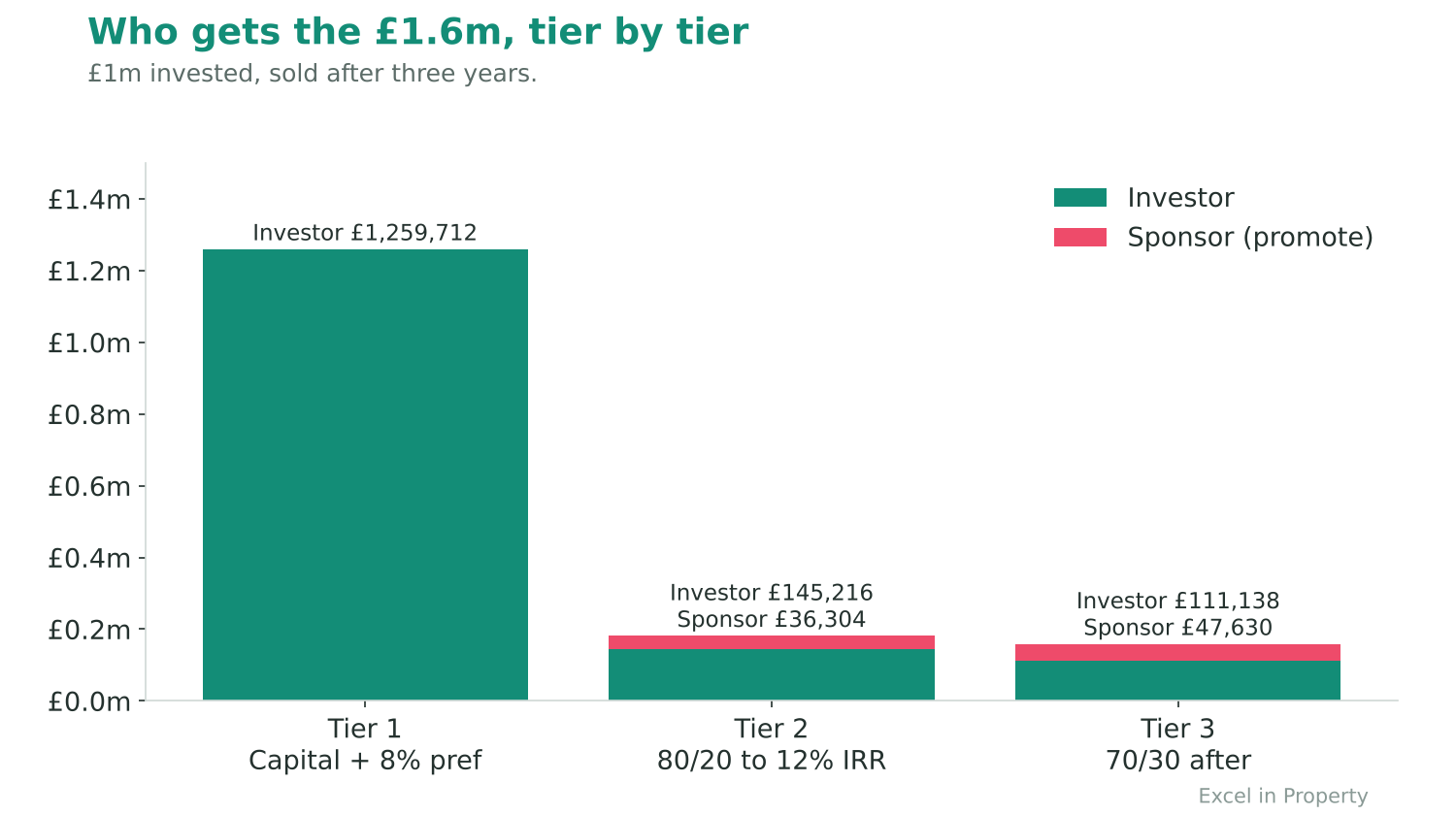
The whole deal returns 16.96% a year (£1,600,000 on £1,000,000 over three years). After the promote, the investor's IRR is 14.9% and their equity multiple is 1.52x. That gap of about two percentage points is what the promote costs the investor.
IRR hurdle or equity multiple hurdle?
An IRR hurdle depends on timing: the sooner investors get cash back, the sooner they clear it. An equity multiple hurdle only cares how many times the money is returned, whatever the timing. Some deals use both, so the sponsor has to meet an IRR and a multiple. For background, see our guides to IRR and the equity multiple.
How do you build a waterfall in Excel?
List the cash available to distribute in each period.
For each hurdle, track a balance: opening balance × (1 + hurdle rate) − distributions.
In each tier, pay the smaller of the cash left and the amount needed to clear the hurdle. For example: =MIN(CashAvailable, HurdleBalance)
Split the tier's cash by the agreed percentages.
Carry any remaining cash to the next tier.
Add a check that investor plus sponsor distributions equal the total cash.
Waterfall example with a catch-up
A catch-up changes the sponsor's share. Same deal: £1,000,000 invested, £1,600,000 returned after three years and an 8% preferred return. The new terms: after the pref, the sponsor receives 100% of cash until it holds 20% of all profit paid so far. After that, everything is split 80/20.
Return of capital and 8% pref: £1,259,712 to the investor. The pref profit is £259,712.
Catch-up: the sponsor receives £64,928, which makes the sponsor's share 20% of the pref profit plus the catch-up (£64,928 ÷ £324,640).
Remaining cash: £1,600,000 − £1,259,712 − £64,928 = £275,360, split 80/20: investor £220,288, sponsor £55,072.
In total the investor receives £1,480,000 (IRR about 14.0%, multiple 1.48x) and the sponsor £120,000, which is exactly 20% of the £600,000 profit. This is a simple full catch-up. Real terms vary, so always read the agreement.
Why do investors compare promote terms?
Two deals with the same property return can give investors very different outcomes depending on the pref, the hurdles and the catch-up. In the first example the investor receives £1,516,066. With the catch-up terms the investor receives £1,480,000. The property and the sale price are exactly the same.
Common mistakes
Measuring the hurdle on the whole project's IRR instead of the investor's IRR.
Ignoring the timing of interim distributions, which changes when each hurdle is cleared.
Not compounding the preferred return on unreturned capital, when the terms say it compounds.
Testing only one exit scenario. See sensitivity analysis in Excel.
No check that the tiers add back to the total.
Frequently asked questions
What is a promote in real estate?
The share of profit a sponsor earns above the agreed return hurdles, in return for finding, managing and delivering the deal.
What is the difference between a preferred return and a hurdle rate?
A preferred return is a tier that pays investors first. A hurdle is the return level that, once reached, changes how the next cash is shared. Many deals have a pref and one or more hurdles.
What is a catch-up?
A catch-up lets the sponsor receive a larger share of cash after the preferred return is paid, until it has received an agreed share of total profit.
What is a typical promote?
There is no standard. It is negotiated deal by deal. Splits such as 80/20 and 70/30 above a preferred return are commonly quoted, but terms vary widely.
Want to learn how to do this properly?
The Mastering Waterfalls and Promotes course builds IRR, equity multiple, combined and catch-up waterfalls step by step. The Academy also includes the 3-Tier Waterfall and Promote Model in the Model Library.
Join the EiP Academy for all nine courses
